
Round table
Offers from universities, business, administration and associations
The operationally oriented round table develops solutions to improve the transition of migrant graduates into working life. In addition to representatives of university career services, it includes representatives from associations and organizations in the job market and the start-up ecosystem.
The Institute for Economics, Labour and Culture is responsible for the specialist support.
You can find the key findings of the roundtable discussion here.

In the follow-up report on the May 2026 meeting, you will find a midpoint assessment of the project.
Press release on the occasion of the constituent meeting of the Round Table on29 March 2024.
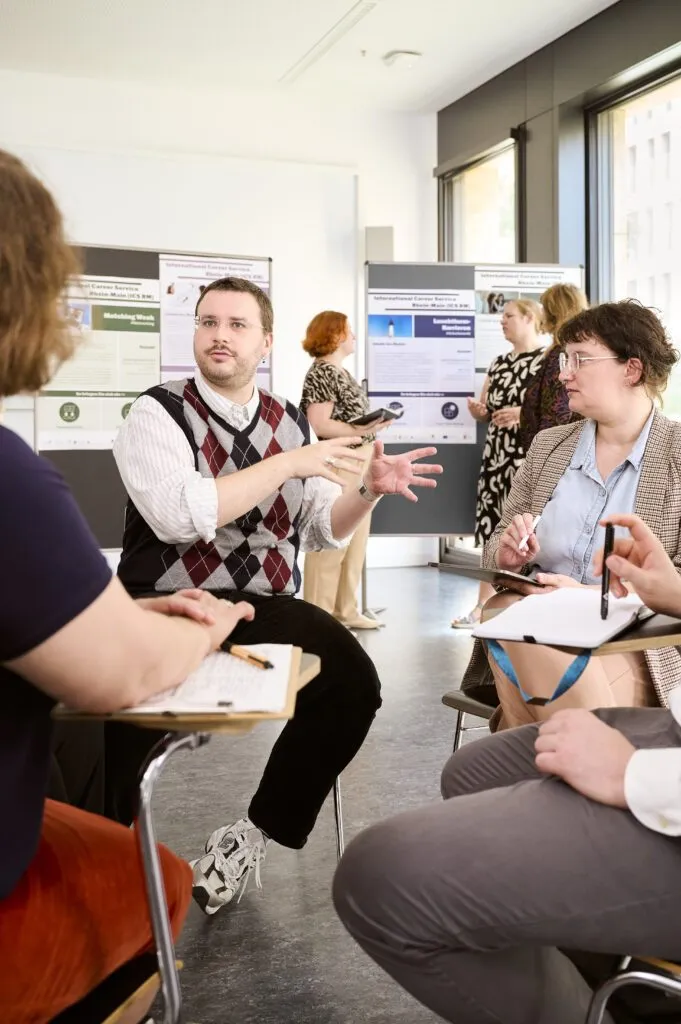
The aim is to support students with an international or intercultural background in their professional development, thus, promoting their successful entry into the professional working world: The round table of the International Career Service Rhein-Main met for the first time on 29 March 2024 at Goethe University (Photo: A. Hoehne).
Our Five Working Groups
Main Area of Focus
The working group addresses issues related to residency status during one's studies and during the transition from school to the workforce.
Moderation
Lars Hollmann, Head of the Welcome & Housing Office, Technical University of Darmstadt
and
Dr. Susanne Jauernig, Acting Group Leader for Academic Success and Integration, Goethe University Frankfurt
Key finding
Information Sheet on the Deemed Validity and Deemed Validity Certificate
This information sheet is intended for affected individuals and employers. It explains the conditions under which a previous residence permit is deemed to remain valid while an application submitted in a timely manner is being processed, and the significance of the deemed validity certificate as proof. It also addresses the right to engage in gainful employment associated with the previous residence permit.
Go to the information sheet on the website of the Hessian Ministry of the Interior, Security, and Homeland Protection.
Main Area of Focus
The working group is working to better support international students in acquiring German language skills relevant to everyday life and their careers.
Moderation
Jonas Fidler, Managing Director of Education Policy, Association of Hessian Business Organizations e.V./HESSENMETALL
Key finding
Recommendation Paper on Integrating German Courses into English-Language Degree Programs
While the number ofEnglish-language degree programs is increasing at many universities and colleges, many international students find after graduation that their German language skills are not yet sufficient for a successful transition to the job market . To facilitate this transition, the ICS RM recommends integrating German language courses more firmly into English-language degree programs.
Go to the recommendation paper.
Main Area of Focus
The working group aims to better connect international students with local businesses and raise awareness of career paths in small and medium-sized enterprises (SMEs).
Moderation
Jens Blank, Head of the Department of Careers, Scholarships, and Awards, Goethe University Frankfurt
Key finding
Development of the “Career Connect” Event Format
To support international students and graduates as they enter the workforce, the working group developed the “Career Connect”event format. It specifically brings together companies from selected industries with students in relevant fields of study and degree programs.
The first event focused on the chemical and pharmaceutical industries. A second event was aimed at students in the fields of civil engineering and real estate management. Additional events, including some for the banking industry, are planned.
Main Area of Focus
The working group focuses on the conditions necessary for long-term professional and social integration in the Rhein-Main region.
Moderation
Dr. Christa Larsen, Director of the Institute for Economics, Labor, and Culture at Goethe University Frankfurt
Key Findings
RAISE – Regional Activities for International Students
RAISE was developed to help international students settle into the Rhein-Main region. The digital platform highlights leisure and social activities and helps students get to know the region and meet new people. Additional activities can be suggested for inclusion in the overview.
Position Paper on Employee Housing as a Location Factor
Housing is becoming an increasingly important location factorin the effort to secure a skilled workforce. Many employers are therefore reviving the employee housing model. Employee housing can also help retain international students and graduates in the region over the long term.
Go to the recommendation paper.
Main Area of Focus
The working group is developing strategies to better inform and advise people interested in starting a business internationally and to connect them with relevant regional resources.
Moderation
Dr. Tina Enders, Project Coordinator for Startup Sustainable, Darmstadt University of Applied Sciences
Key finding
Guide to Self-Employment for International Students ( self-employment )
International students who wish to engage in self-employment face bureaucratic challenges and must pay particular attention to issues related to residency law. This guide provides an overview of key legal and organizational requirements. It thus offers initial guidance for international students who wish to become self-employed or start a business.
Go to the guide.
We Want to Hear About Your Experiences – The Perspectives of International Students and Alumni
International students and alumni know from their own experience what conditions (might) make the transition from college to the workforce easier and where obstacles still exist.
We would like to incorporate these perspectives more fully into the work of the Roundtable and its working groups.
For example, you can get in touch if you have experience with the following topics:
- Right of Residence and Government Agencies
- Learning German
- Job Applications and Career Starts
- Working at Regional Companies
- Finding Housing and Settling into the Region
- Founding and self-employment
We would be delighted if you could share your experiences at the roundtable!
We welcome feedback in German and English.

Aicha Bah-Diallo studied political science and sociology at Goethe University Frankfurt. She has been working at jumpp – Frauenbetriebe e. V. since 2019. Since 1984, jumpp has been supporting women in entering the job market becoming self-employed, in particular by counselling founders and entrepreneurs counselling issues relating to self-employment throughout all phases of their business.

Jonas Fidler studied economics in Frankfurt after completing his A-levels, vocational training and work experience. Following a traineeship, he worked as a vocational school teacher before joining the employers' associations. The Federation of Hessian Employers' Associations (VhU) is the umbrella organization of the Hessian economy. It represents the interests of 86 employers' and business associations.

Stefan Hagen studied education and educational sciences. He has been working at PQZ Hessen since 2021 and now serves as its director. PQZ Hessen aims to establish a state-wide structure in Hesse that identifies international professionals in the health and nursing sectors, attracts them to Hesse as a place to work, and provides them with further training as needed. PQZ Hessen supports employers through a structured and personalized consulting process.


Björn Krienke studied Public Management at the University of Kassel and Administrative Sciences at the Federal University of Applied Sciences. As an employee of the Federal Employment Agency, he held various management positions in Hesse. From 2015, he worked as a member of management at the Gießen and Frankfurt am Main employment agencies. In February 2023, he took over as Chairman of the Frankfurt am Main Employment Agency. Around 1,000 people are employed at the Frankfurt am Main location. Their task is to secure people's livelihoods and support them in their integration into work and professional life.

Mona Mozayyani studied musicology and education at Goethe University Frankfurt. She has been working in the field of refugee aid since 2023. At the round table of International Career Service Rhein-Main , she can contribute the perspective of international students together with other current and former students.

Daniel Schrapp, M.A., has been a consultant for political communication and sustainability at the employers' association HessenChemie since 2018. He previously studied political science and history at the Ludwig Maximilian University of Munich and then worked as a trainee in the European office of Siemens AG in Brussels. Mr. Schrapp has also been a TÜV-certified sustainability manager since 2023.
HessenChemie has represented the industry-specific labor and social law interests of its 310 member companies with 105,000 employees since it was founded in 1947.

Anna Strohmann advises and supports companies on how they can recruit, retain and develop skilled workers. One focus is on the international immigration of skilled workers and advice on the recognition of foreign professional qualifications. As a public corporation, the IHK Offenbach am Main represents the regional economy of the district of Offenbach and the city of Offenbach am Main.


The WELCOMECENTERRhein-Main the central contact, service, and advisory point for international workers, skilled professionals, and executives, as well as for trainees and students; it also serves companies, businesses, and government agencies across all sectors in Rhein-Main that are interested in employing and/or training international personnel. The WELCOMECENTERRhein-Main a joint initiative to secure a skilled workforce under the leadership of the State of Hesse, operated by the Frankfurt am Main Employment Agency in cooperation with the Frankfurt am Main Chamber of Industry and Commerce, theRhein-Main Chamber of Crafts, the FrankfurtRheinMain Regional Association, and FrankfurtRheinMain GmbH.
Please feel free to contact:
Dennis Schmehl
Research Associate at the Institute for Economics, Labor, and Culture at Goethe University Frankfurt
Email: schmehl[at]em.uni-frankfurt.de


